Accra speaking: when our old mobile phones end up in Ghana
Europe’s electronic waste is being exported to Ghana where it is transforming a once-sparkling lagoon into a toxic, foul-smelling dump site where tens of thousands of people live and work.
The journey from central Accra to Agbogbloshie takes 15 minutes by taxi. Mike Akane uses the time to tell his story. It is the story of a rapid transformation: from a natural idyll in the west of Ghana’s capital to a gigantic dump site. Akane used to drive out to Korle Lagoon to watch the birds.
Today, thick smoke from burning plastic mingles with the stench of a dump site as we step out of the taxi and into stifling tropical heat. “So this is Agbogbloshie,” says Akane. Cries can be heard drifting over from the Onion Market, accompanied by the constant din of tuk-tuks and lorries honking their horns.
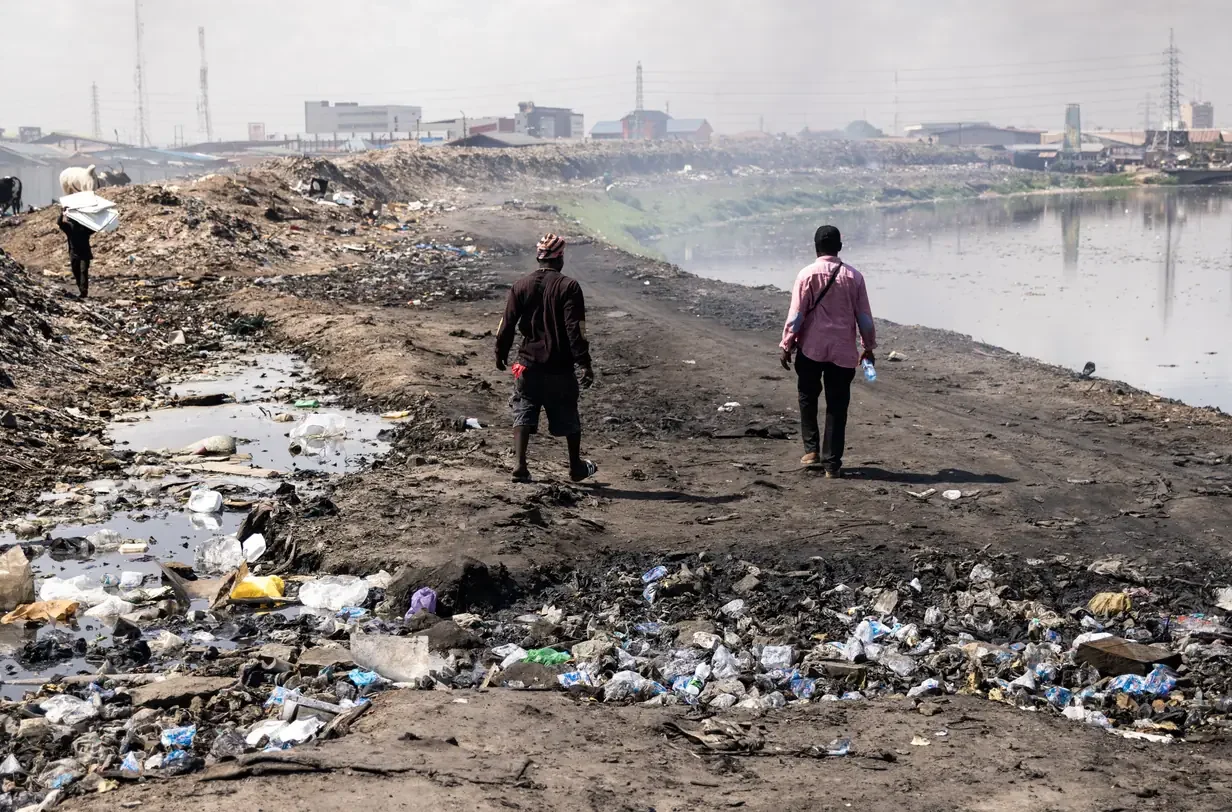
In the national and international media, Agbogbloshie is portrayed as a slum. Over 5,000 people live here, and up to 25,000 people from other parts of Accra are said to depend on the jobs this place has to offer. These can include jobs at the bazaar, in the barbershops, in the bars – but most jobs involve working on the western shore of the lagoon: a dump site that, just four decades ago, was a wetland where little stints, terns and striated herons used to flock. “All electrical and electronic devices that enter the country end up here sooner or later,” says Mike Akane. “Including those from Switzerland.”
But how do Switzerland’s computers, televisions and smartphones end up at a dump site in a West African slum? The route winds its way through numerous countries. People have roughly as many notions about what a circular economy means as there are retailers involved in trading used electronic devices. From Agbogbloshie, this article attempts to track what happens to devices that are disposed of as electronic waste in Europe – and are given a second life here in Ghana.
TIP TOE LANE
Old smartphones, big dreams
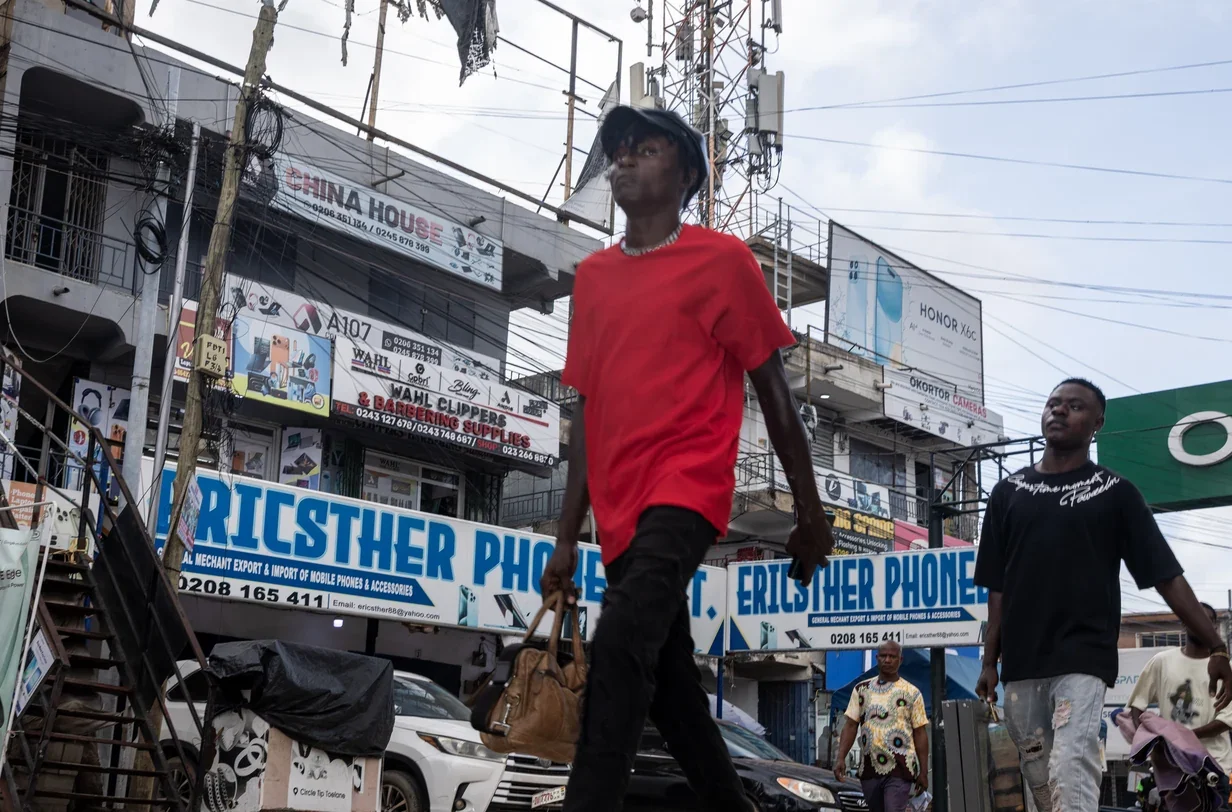
The second life of these devices begins, for example, at Tip Toe Lane, the electronics market on Accra’s ring road. Men sit shoulder to shoulder beneath a sea of parasols where they display their goods: piles of iPhones, Samsungs and Xiaomis, all of them shipped in from abroad, all previously used. Behind the men, rows of street buildings offer a similar sight: one shop window after the other, each one full of MacBooks, tablets and smart TVs.
“You can find anything here,” says Shardey, who runs a small stall, and adds: “and anyone – even people with PhDs.” For him, too, Tip Toe Lane was merely a Plan B – or perhaps even Plan C. To lift his family out of poverty following his father’s death, he, like so many others here, wanted to become a professional football player. But he didn’t have the necessary money.

A friend advised him to give mobile phones a go. Ever since, Shardey has been sitting here from Monday to Saturday, waiting for someone to come along and ask: “How much do you want for this one?” Shardey’s customers come from the middle-income group of Ghana’s society and include students, fathers and workers. Shardey’s merchandise includes an iPhone XR and can be bought for 1,650 Ghanaian cedi, which is equivalent to 112 Swiss francs. He bought it a few weeks earlier for 1,500 cedis and hopes to sell it for a profit of around seven Swiss francs. The annual median income in Ghana is below 1,500 Swiss francs.
“It’s a good business,” says Shardey. He knows people who have worked their way up here, who started out with a small stall and now live in houses, drive nice cars and own a whole fleet of electronics shops. Shardey is not one of them. Or at least not yet – he is still hopeful. In the meantime, he sells enough to pay the rent on his flat, afford his two children’s school fees and provide his family with food.
“This job has done more for my family than the government has,” says Shardey, alluding to the chronic shortage of jobs. No matter whom you speak to in Ghana, everyone says: there aren’t enough jobs available. And the jobs that are available are only given to people with the right connections. Numbers confirm: one in three Ghanaians aged between 15 and 24 is unemployed. Corruption is widespread, formal education less so. Tip Toe Lane gives everyone a chance.
What Shardey omits to mention: it was precisely this government that laid the foundation for him to be sitting here today, dreaming of a bright future. US author Alexander Clapp describes this in his book “Waste Wars”: as the internet began its triumphant advance at the turn of the millennium, impoverished Ghana saw an opportunity for economic recovery. It set out to become the second country on the continent with full internet connectivity. International corporations relocated their call centres from South-East Asia to this English-speaking country.
Clapp writes, “Bringing the internet to Ghana was one thing. Getting millions of Ghanaians online was another.” Infrastructure alone is not enough. Equally indispensable are the electronic devices with which to access the internet. A seemingly insurmountable obstacle for a country in which a large proportion of the population lives on less than one US dollar a day. While countries such as Uganda ban imports of used electronic devices, Ghana is the only country in Africa to have abolished all import duties on used computers, monitors and printers.

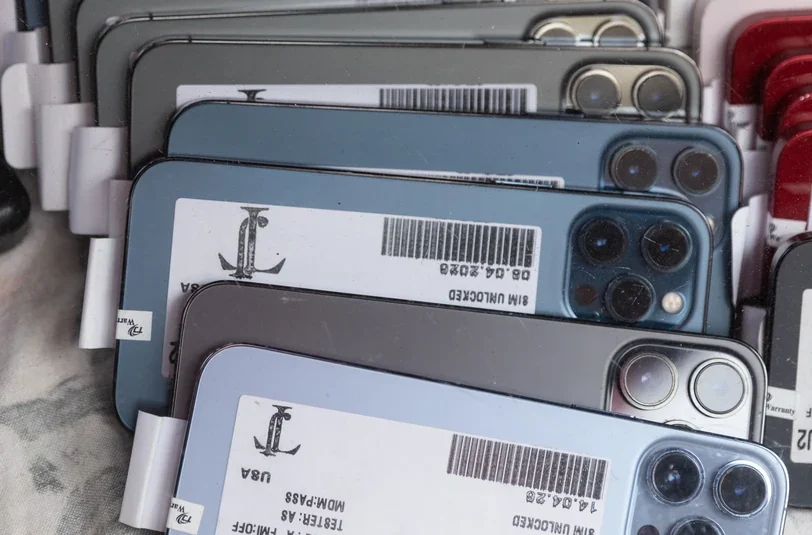
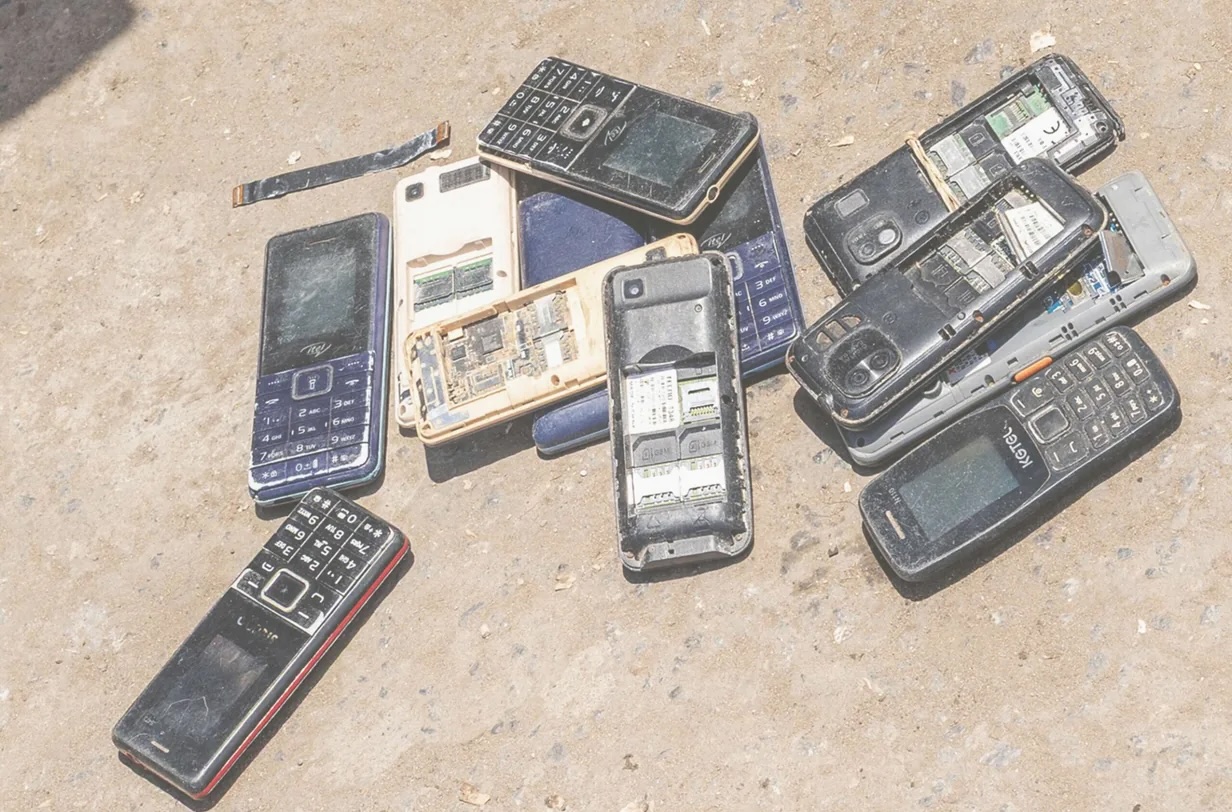

Shardey’s friends bring him suitcases full of equipment when they return to Ghana, “from Europe, the US, China and Dubai”, he says. These traders are often Ghanaians living abroad, but they also include Nigerians, Chinese and Lebanese. Photos of the devices sometimes already circulate in WhatsApp groups, TikTok videos and on Facebook before they even arrive. “I usually buy from a Lebanese guy on WhatsApp,” says Shardey, “or over at the American Mall.” Most of the mobile phones and laptops on display are labelled with a sticker: tested, 100 per cent functionality. This sticker is required – at least theoretically.
Route to Ghana involves illegal networks – and legal donations
Under the Basel Convention, which has been ratified by almost all UN member states except the USA, only equipment that has been successfully tested by the exporters may be imported into Ghana. Officially, around 150,000 tonnes of used electronic devices arrive in Ghana every year, many of which are beyond repair. Illegal shipments are rarely detected: customs authorities in Europe focus more on what comes in, and for customs authorities in West Africa, it is “notoriously difficult” to differentiate between electronic goods and electronic waste.
Illegal e-waste from Europe repeatedly ends up in Ghana. This has been documented by investigations in which defective electronic devices were fitted with tracking devices.
The authorities are rarely successful in their investigations. Yet every now and then, they offer a glimpse into a clandestine market: in 2023, Spanish authorities arrested 43 suspected members of a network that had allegedly smuggled around 5,000 tonnes of electronic waste – equivalent to 200 lorry loads – via the Canary Islands to West Africa, and this with the help of official recycling companies.
Networks such as these are not only active in Spain. Investigations in which electronic waste was fitted with tracking devices revealed the waste is also illegally shipped to Ghana from Germany and France – the two countries to which the vast majority of Switzerland’s electrical and electronic waste is exported.
In 2024, around 1,100 tonnes of irreparable, used electronic devices crossed the Swiss border into other countries. This figure increased to 31,100 tonnes when individual components such as cables and circuit boards were included, rather than just the devices per se. The majority of this waste can be expected to be processed properly. However, some of it also ends up in illegal export channels. Six per cent of deliveries tracked via GPS left Europe illegally, bound for Africa and Asia.
On top of that, authorities only record the export of devices that no longer work. Those that might still be usable are permitted to cross borders without authorisation when labelled as donations or merchandise, even if the remaining operating lifetime is a few years at most. Swiss organisations also donate laptops to Ghana.
E-waste from Europe repeatedly makes its way illegally to Ghana. Investigations have shown this by fitting discarded electronic devices with tracking devices and tracing their journey.
“No repair cable detected”
A few steps further down bustling Tip Toe Lane, Enoch fumbles for his precision screwdriver to replace a smartphone screen. The repair technician rummages through the brackets, camera parts and circuit boards in front of him with his left index finger. It takes him ten minutes to complete his task. Cost: 50 cedis, 3.50 Swiss francs. Even though there are days when he has no work at all, he still manages to earn around 500 cedis a week – 35 Swiss francs. “I can survive on that,” says Enoch airily.

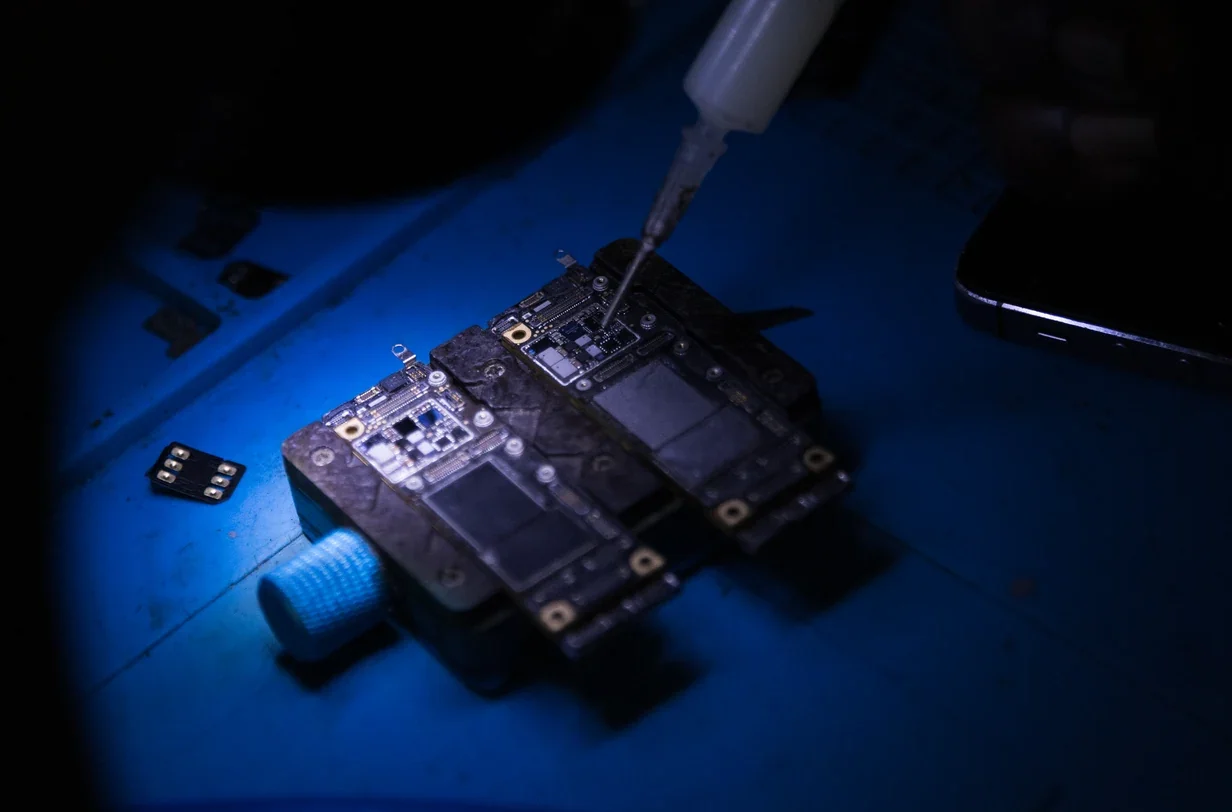
He carries on tightening the screws nimbly, checks his work, tightens the screws a little more. “Come,” he says after completing the repair, and leads me to the rear stairwell of a mall. Enoch has to duck to pass through a hidden swing door. We enter a workshop, which is really more of a cave than a room. Two people are sitting there, a Mac on one desk, a laptop and a microscope on another. The air down here is pleasantly cool; there must be an air-conditioning unit running somewhere. What Enoch wants me to see: while “simple” repairs for the masses are carried out in the hot, open space, here at the laboratory, technicians work their real magic.
One of his colleagues demonstrates his skills: he uses a special device to see whether the used iPhone in his hand can detect that its battery has just been replaced. “No repair cable detected” appears on the display. Next to it is a battery icon: “100 per cent”. Nobody seems particularly impressed: another day, another dollar.
Enoch grew up surrounded by electronics. This reflected the success of Ghana’s government plan in the early 2000s: vast quantities of used electronic devices poured into the country from all over the world. In 2000, Ghana did not have a single internet café. Two years later, it already had more than 600. Accra became home to one of Africa’s first supercomputers.
But along with the devices came the waste: faulty computers, printers and fridges that were declared as donations or functional used goods. Although the Basel Convention prohibiting such exports was already in force, there was an almost complete lack of local controls and regulations.
LAPAZ
Operationen unter freiem Himmel
The man whom everyone simply calls “Doctor” works 30 minutes north of Tip Toe Lane in the Lapaz neighbourhood. “These have just arrived from the UK,” he says, standing in front of the shed where he stores flat-screen TVs. Here, the street is lined with storage sheds. When his stock begins to dwindle, Doctor orders more from Europe. He picks up a newly delivered TV and takes it under a canopy where he places it on a plastic table that appears to have once been white, with the screen facing downwards.
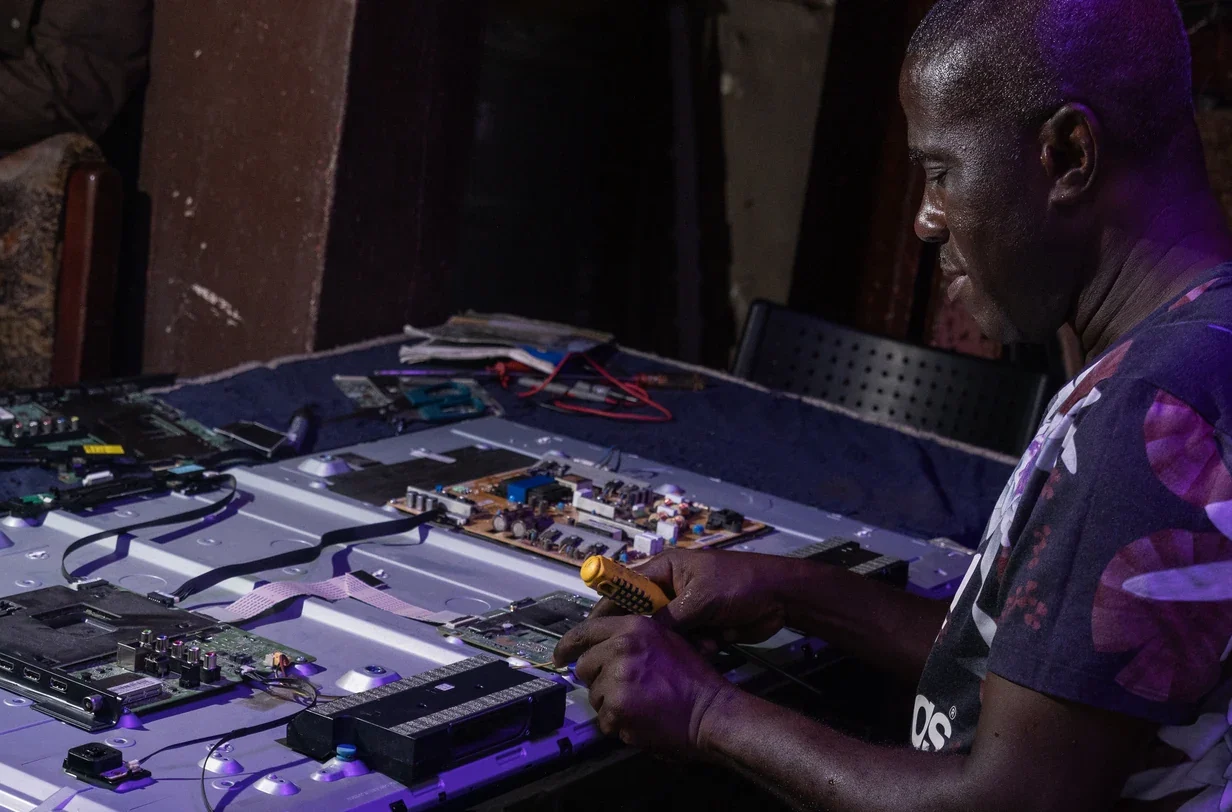
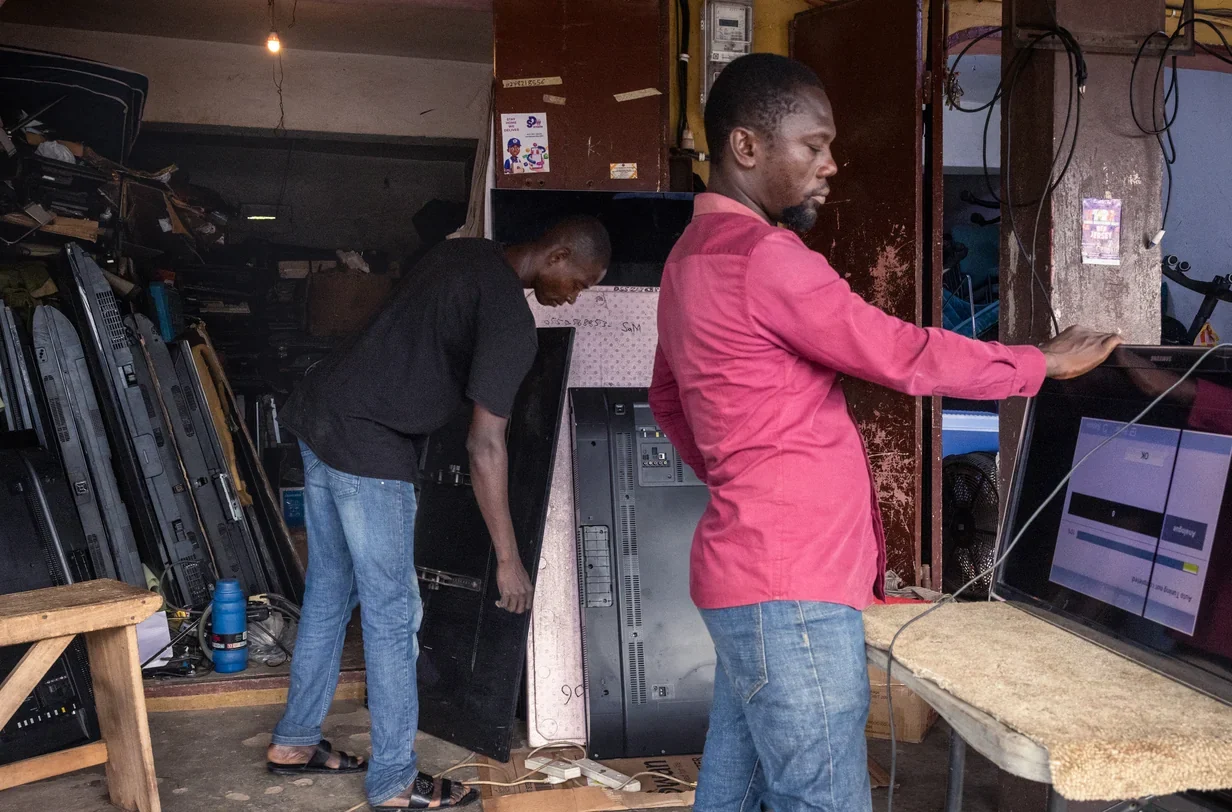
Doctor reaches for his surgical instruments, unscrews the angular plastic casing, plugs in a cable and lifts his patient to check for signs of life: nothing. The screen remains black. He tinkers with the motherboard – the brain of the smart TV – and the image-processing circuit board – its nervous system. Diagnosis: the brain shows some activity but cannot transmit the information correctly. Surgical procedure: a transplant of the image-processing circuit board.
After a few minutes’ work with a screwdriver, the TV works perfectly. “The sets are much easier to repair than they used to be,” says Doctor, who has been in the business for 25 years and started out with cumbersome cathode-ray tube televisions. Nowadays, everyone wants a smart TV.
Each one costs him around 1,500 cedis, or 100 Swiss francs. He can sell them for around 2,500 to 3,000 cedis each – provided they work. This also means that Doctor buys devices that are only allowed into the country because they have been officially classified as recycling material. None of the TVs in his warehouse were tested beforehand. “Out of 20 devices, about seven still work,” he says. He tries to repair the remaining 13, but for at least one of them, the diagnosis will be “terminal”. For 100 cedis – 7 Swiss francs – he can still sell the “remains”.
Doctor takes the repaired TV back to the storage shed. In passing, he points to a man in a green T-shirt who is staring at his smartphone outside next door’s warehouse. “He’s from the UK,” he whispers. “I’ll get my next delivery from him.”
Merchandise can be found on Facebook Marketplace and at official recycling centres
The man in the green T-shirt is called Kingsley. He is from Ghana and leads two lives: during the night, he works at a factory in Oxfordshire; during the day, he trades in waste. His goods: anything that can be bought cheaply in large quantities, such as used TVs, laptops and chairs. “Even when I’m here in Ghana, I check what’s on offer in Oxfordshire,” he says as he scrolls through Facebook Marketplace.
Kingsley makes a living from the fact that, in Europe, it is often cheaper to replace appliances than to repair them. He also profits from the circumstance that more and more TVs, laptops and smartphones are being bought at ever shorter intervals. Anyone who, like him, imports large quantities of these devices into Ghana can make a relatively decent living.
He finds his goods not only on Facebook Marketplace, but also at official recycling centres. Both sides benefit: the recycling centres save on costly processing, and might even make a bit of money, while Kingsley gets the resources he needs. “I always tell customers that the goods are going to Ghana, but they don’t really care, they just want to be paid.” Four times a year, Kingsley fills a shipping container. Unlike the traders, people who dropped off their TVs at recycling centres are usually unaware of the fact that their devices are about to embark on a journey halfway around the world.
The container shipment usually takes three weeks to reach the port of Tema, an hour’s drive east of Accra. Shipping costs around 4,000 British pounds – or around 4,300 Swiss francs, says Kingsley, plus 8,000 British pounds in import duties. The total costs have risen in recent years due to the coronavirus pandemic, geopolitical tensions and Ghana’s stricter import policies.
Some expect the higher prices to reduce the amount of electronic waste that ends up in Ghana. Kingsley remains undeterred: “When I buy the goods, I know exactly how much I’ll get for them in Ghana.” The other traders are likely to find themselves in a similar situation.
In the recycling industry, there is no such thing as waste – everything is a resource. Really?


German-Ghanaian Nana Yaw Konadu is working towards his dream: a truly circular system for devices and materials that benefits everyone. Ghanaians, Europeans and the environment.
Nana Yaw Konadu also imports used appliances into Ghana on a large scale, but only those that still work. The German-Ghanaian is the founder and CEO of Electro Recycling Ghana, one of the country’s largest recycling companies. His dream: a truly complete cycle that benefits everyone: Ghanaians, Europeans, the environment.
The principle is simple: recycled materials are increasingly in demand in the Global North – partly because companies are more often legally obligated to use them. At present, European companies import most of these materials from Asia, says Konadu, calling this “a missed opportunity”.
According to Konadu, there are actually two missed opportunities. The first: European companies could sell their old devices to Ghana, where people still buy an iPhone 7 or 8. The second: anything that can no longer be sold is recycled, and the recycled materials, such as copper and plastic, could be sent back to Europe.
“This market has huge potential,” Konadu says with conviction. He already imports nearly 40,000 used TVs, laptops and smartphones a year. Every year, he recycles 15,000 tonnes of electronic waste at a plant an hour’s drive north of Accra. He receives support not only from Ghana’s highest echelons, but also from the German Society for International Cooperation.
The visit to the recycling plant has to be cancelled at short notice: it is the rainy season, the neighbour’s drainage is blocked, the terrain is covered in knee-deep water. Konadu does not let himself be deterred by these kinds of setbacks. During the conversation, he strings one superlative after another: the largest second-hand platforms and the largest electronic recycling initiatives would be interested in his plans. From Germany, from Austria, from Switzerland.
To him, it makes perfect sense: the benefits of shipping electronics to West Africa are two-fold. Not only does it extend the lifetime of a device, but it also boosts profits. “If you scrap them in Europe, you might get two US dollars per device, but in Ghana people are still willing to pay 100 dollars for the same device.” Nevertheless, European companies are reluctant to go ahead, as the stigma surrounding Africa is too great.
AGBOGBLOSHIE
Testimony to Black Friday sales frenzy
Mike Akane would prefer to see no devices imported into the country at all. For him, Agbogbloshie is a prime example of everything that is wrong about the trade of used electrical and electronic goods. The environmental activist sees two fundamental problems. Firstly, it is impossible for Ghanaian customs officials to inspect all the equipment arriving in shipping containers. And secondly, nobody checks whether the devices that bear a sticker saying “tested” still actually work. Not to mention that “Absolutely anyone can apply a sticker – there’s nothing to it!”


Entrepreneur Nana Yaw Konadu describes his business model like this: “In Europe, you get two US dollars for scrapping a device. Here, people will still pay 100 dollars for that same device.“
Around 20 per cent of the electrical and electronic devices shipped to Ghana require repairs before they can be sold, and a further 15 per cent directly end up in an official or unofficial scrapyard. The situation is improving. According to a study, around 70 per cent of the 215,000 tonnes of electrical appliances imported in 2009 were faulty.
Akane talks about excessive consumption in the West, the artificially shortened operating lifetime of electronic devices, and the consumer society revolving around Black Friday. In Switzerland, too, sales of electronic devices keep increasing. Consequently, more and more is being thrown out, too. Every two to three years, consumers in Switzerland want a new smartphone, while businesses replace their IT equipment at similar intervals. From an environmental perspective, this makes little sense. Over the past 30 years, Swico has collected around one million tonnes of discarded electronic equipment, with a further roughly 130,000 tonnes expected each year.
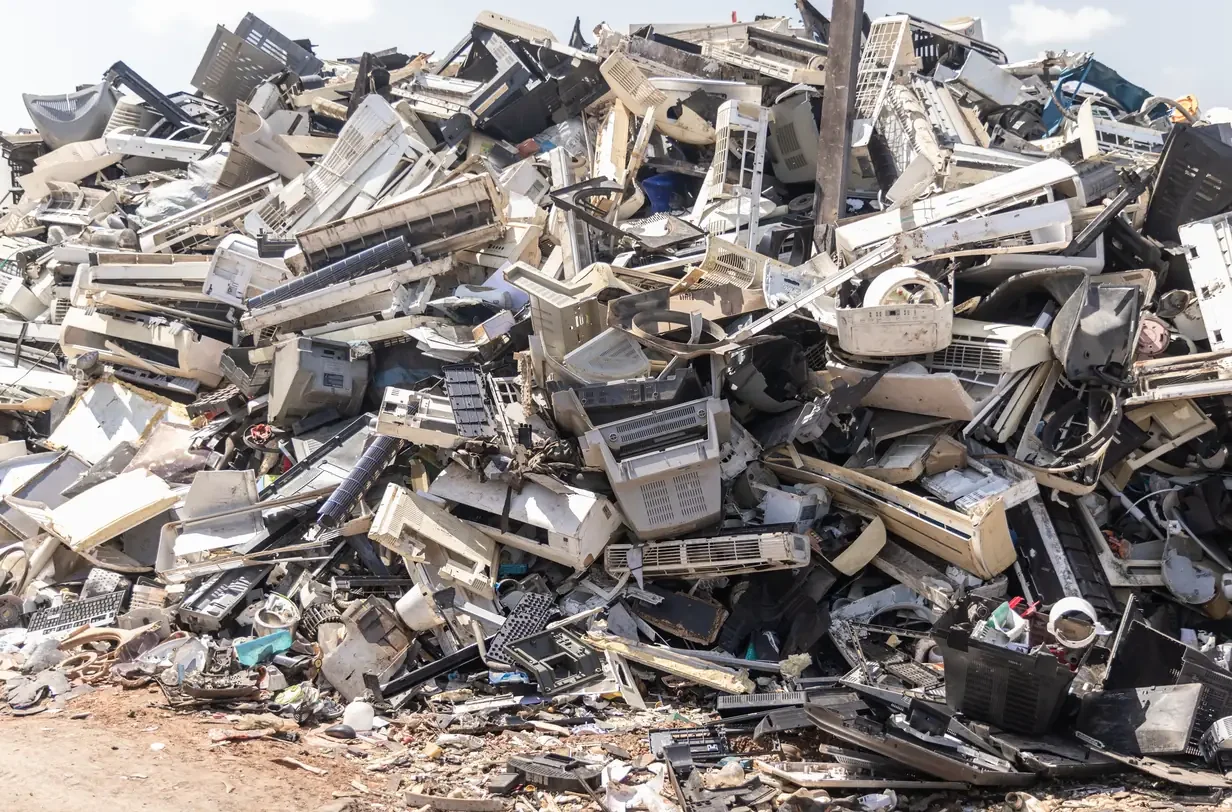
Akane walks through the Onion Market on Agbogbloshie’s main street, turns left before the lagoon and comes to a halt in front of a dump site. Next to him, plastic that once encased grey monitors, white air-conditioning units and black television units is piled high. Glass from shattered screens crunches under his feet.
More and more electronic devices are being sold in Switzerland. And, accordingly, more and more are being discarded: Swico collects around 130,000 tonnes of end-of-life devices every year.
Jacob lives with three of his siblings in a tiny room somewhere in the labyrinth of the informal settlement of Agbogbloshie. When it rains – which it does frequently and heavily during the rainy season – water drips from the ceiling. The little path outside the room floods with rainwater and mud. To Jacob, Agbogbloshie is “really awful”; it is one of the most polluted places in the world. Babies here are exposed to an increased risk of developing cancer the moment they drink their mother’s milk. Three out of four residents have dangerously high levels of lead in their blood.
Jacob’s ultimate goal is to pack up and leave. To achieve this, he relies just as much on the second-hand HP laptop sitting in the corner of the room as he does on the dump site on the other side of the lagoon. Without the laptop his mother bought him four years ago for 2,000 cedis – 135 Swiss francs – he would not be able to study at university. Without his job at the dump site, where he drags the magnet from a disused loudspeaker behind him to collect iron fragments from the ground, he would not be able to contribute any money towards his studies. The laptop is slow, the work is dangerous, “but I have no choice,” says Jacob.
At the dump site, environmental activist Akane bends down and examines a sticker on a monitor. Time and again, he comes across the names of European universities, libraries and IT companies on the discarded devices. Every now and then, he sends them an email: “Did you know that your printers, monitors and computers have ended up in a dump site in Ghana?” For example, to a university in the Netherlands. “They couldn’t believe it. They said they had handed the equipment over to a recycling company.” They thought they had done everything right. However, the final destination was not a recycling centre in Amsterdam, but a dump site in Accra.
And yet, this is not the whole truth. The components of the devices live on. At every turn, people are smashing fridges, microwaves and air-conditioning units until the scrapyard’s most sought-after material comes to the fore: copper in the form of copper coils, copper wires and copper windings.
Burned plastic, black smoke, scarred bodies
Mike Akane examines a sticker on a discarded monitor. The environmental activist repeatedly finds the names of European universities, libraries and IT companies on discarded devices.


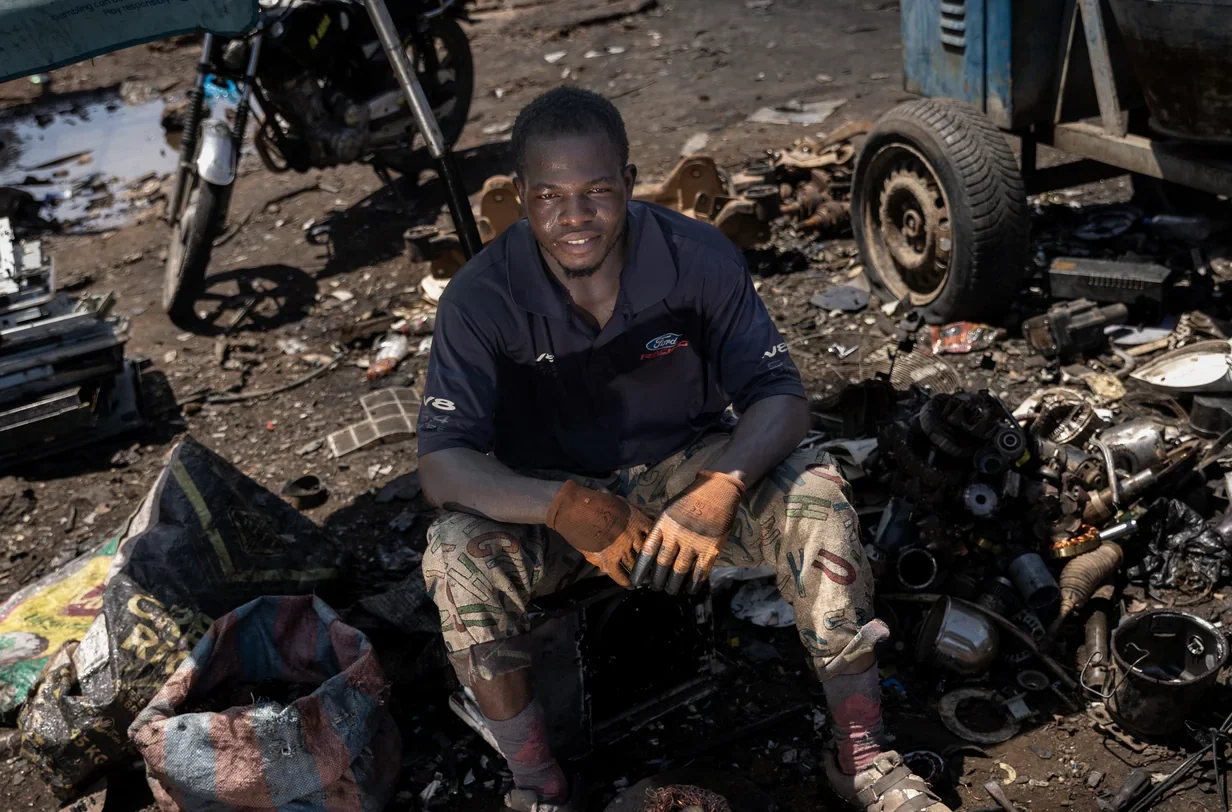
Mohammed Awal, who works as a “burner boy”, has a ritual scar beneath his right eye; it tells of his origins in the impoverished North. Countless other scars, spread all over his legs, arms and hands, bear witness to a life of hard work.
His job is to bring cables to the shore of the lagoon, set the plastic alight and tend the bluish fire until only the metal remains. Under the blazing midday sun, he stands less than a metre away from the flames, trying to inhale as little of the thick black smoke as possible.
It is one of the unhealthiest jobs in the whole dump site. If Awal cuts himself, he risks contracting tetanus; every time there is a fire, burned plastic particles lodge in his airways. After just a few minutes standing next to the flames, the throat starts to feel scratchy.
Once the flames go out, Awal cools the copper with water and throws it onto a pile: from there it goes to one of many weighing stations. The Nigerian in charge pays 55 cedis per pound of copper, or 3.50 Swiss francs. Most of the money does not go to Awal, but to his client, who bought the electronic waste.
In 2021, the army cleared the scrapyard. Recycling – and with it the problem – initially shifted to the neighbouring residential area. Shortly afterwards, it returned to the cleared site.
For one cedi more per pound, the Nigerian can resell the copper to clients of his own – Chinese, Indian and European buyers. There, the copper recovered in Agbogbloshie will be reused in appliances that may one day end up back here, at the dump site next to the Korle Lagoon.
As a burner boy, Awal earns enough to rent one of the tiny rooms in the settlement for his family of five – but never enough to move up the ladder or leave. His next step up the career ladder? To weigh copper, aluminium or iron himself. However: “You need an industrial scale for that,” says Awal. “And for that, you need capital.” Awal lives for his children’s future. “Under no circumstances do I want them to stay here.”
It is clear not only to environmental activist Mike Akane that a place like Agbogbloshie – which even its own residents refer to as Sodom and Gomorrah – should not be allowed to exist. The government had the army clear the dump site in 2021. However, recycling activities – and with these the core of the problem – initially shifted to the neighbouring residential area, only to return to the cleared terrain a short while later.
The people here depend on the work. Like Jacob, the student, and Awal, the burner boy, they are caught in a catch-22. They don’t want to be here because they know how dangerous it is. But they have to be here to earn at least a little bit of money.
Mike Akane gets into a taxi and heads back towards the city centre. He remains silent for a long time before he eventually concludes: “This is our global economy at work.” He sounds resigned. He does not appear to hold much hope for change at any time soon.

was born in 1988. The journalist and photographer has held positions, including editor-in-chief of “Vice Switzerland” and content strategist at Wirz Communications. He now writes for publications such as the “New York Times”, “Stern”, “Der Spiegel” and “Die Zeit” as a freelancer. He lives in Cairo, Egypt.