A lifetime of rubbish
I produce 1.9 kilograms of rubbish every single day. Forty tonnes over a lifetime.
40 tonnes of waste. That is how much waste every person in Switzerland produces on average over the course of a lifetime.
Having just arrived in the hereafter, I step into a vast white hall to discover the museum of my rubbish. I am the only visitor.
I walk across a black carpet made from the wear and tear on my bicycle tyres: ninety grams of microplastics per year that my brake marks left on the roads of Zurich – the equivalent of a bar of chocolate. Woven into it, too, the wear and tear from my trainers where I released tiny particles with every step I took. If I had driven a car instead of riding a bicycle, the carpet would be fifty times longer.
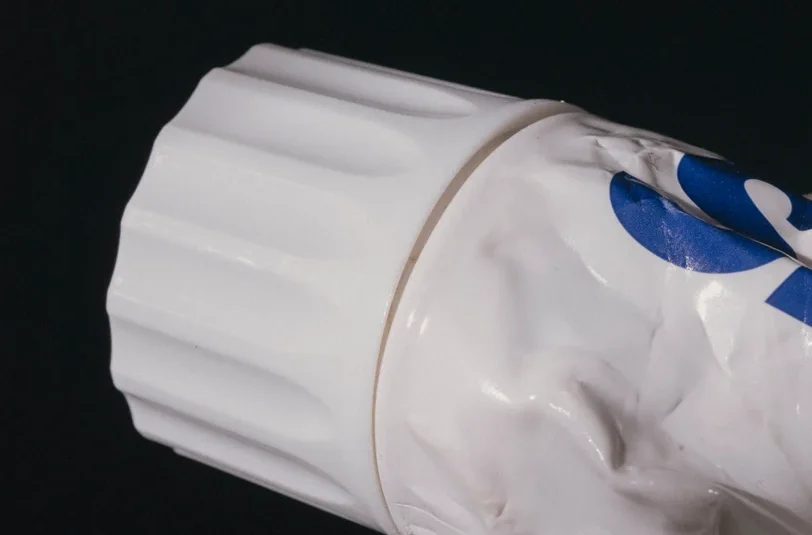
I follow a row of five hundred tubes of toothpaste, sorted by colour. Twelve kilometres of dental floss, rolled into a ball. Seven hectolitres of shower gel in a basin. The adjacent aquarium holds plastic beads and polymer binding agents that entered the wastewater unfiltered. Ten thousand rolls of toilet paper piled high to look like white trees. Around fifteen spruces were felled for this purpose. I sit for a while in the little cluster of spruce growing in the museum’s courtyard. If I had had two children, it would have been twice the size – about as large as a tennis court. I would then also see a mountain of twelve thousand nappies, which would take five hundred years to decompose – except for the microplastics that would never break down.
We have altered the Earth’s crust, both chemically and physically.
We are creating a new geological layer.
In a way, that’s an Olympic achievement.
I walk on. Hanging above me are hundreds of little clouds of CO₂, each weighing two hundred grams – the remnants of my weekly train journeys from Zürich to Baden and back. Amidst all this, a tall pile of clothes: my two hundred T-shirts, an inseparable blend of cotton and elastane that cannot be recycled.
Moments of wonder in the Gallery of PFAS: forever chemicals. I see microscopic images of PFAS from waterproof clothing, Teflon frying pans, baking paper, pizza boxes, paper plates and disposable tableware. Per- and polyfluoroalkyl substances – the name itself is hard to digest. Nothing natural can break up these compounds – neither bacteria, ultraviolet light, heat, nor water. There are over ten thousand different PFAS. They are water-soluble and potentially air-borne. When you wash a jacket or throw away a frying pan, PFAS end up in the wastewater. Wastewater treatment plants cannot filter them out, so they end up in rivers and the sea. They can be found in Antarctic rainwater and, at the other end of the Earth, in the blood of polar bears – and in every human body. They come to rest as deep-sea sediment. PFAS are the indelible mark we humans leave behind on this planet. Millions of years from now, geologists analysing the Holocene Period in more detail would be able to identify the beginning of the era of fluorine chemistry. We have altered the Earth’s crust both chemically and physically – in all modesty, an almost superhuman feat. We are currently adding a new layer to Earth, the Anthropocene. If you think of the planet’s age – four and a half billion years – as one single day, we accomplished these changes in the millisecond before midnight. As a projection on a screen, I can see the fluorine and carbon particles floating through the deep sea in slow motion. This is called marine snow.

I walk past a mound of cigarette butts from my ten years of smoking hand-rolled cigarettes. As a museum visitor, I am allowed to decide what I want to do with my chewing gum. I used to chew about seven pieces of chewing gum a day, Stimorol Peppermint. Now I am invited to choose: I could either use all that chewing gum to paper the walls of a replica of my flat, or I could build a tower outside as tall as the Burj Khalifa.
Tucked away in a corner are memories I had forgotten: my unused inflatable boat. The faded air mattress on which I drifted through the summers of my childhood. The scuba glasses I used in search of fish. Why have these plastic items not been recycled? In Europe, plastic waste is often sorted, loaded onto cargo ships and shipped to the Global South where it is tossed into open landfills or the sea. From the sea, tiny plastic particles end up in the bellies of fish, which in turn land on our plates.
As in other museums, shards of pottery are exhibited here, too. They bear the stamp Ikea. Future generations of archaeologists might be led to believe that this is the name of a goddess revered throughout the world. It can take over one million years for ceramics and glass to degrade in soil. Next to the shards are piles of disposable cutlery, which I used to eat the occasional takeaway meal. Then hundreds of kitchen sponges, cloths, scrubbers and toilet brushes, which I used to keep my own mess at bay, only to create a different sort of mess in the process. My two hundred toothbrushes: a future index fossil.
The deepest digital traces we leave behind are not selfies in front of pristine mountain landscapes, crystal-clear lakes and wild rivers, but vast amounts of metadata. For future AI, this data waste will be the raw material from which it learns what it actually meant to be human.
I read the information boards about the Big Bang of the plastic universe. We triggered it in the 1950s. The period up to the present day is referred to as the “Great Acceleration”. Almost every piece of plastic produced since 1950 still exists today, either as a fragment or as microplastic. Disposable nappies, PET bottles and vacuum wrapping have been around since the 1960s. My toothbrushes, chewing gum, tyre wear and the casings of my electronic devices are embedded as particles in rock layers. This new rock is called plastiglomerate and will exist for thousands of years in some places, and millions of years in others. We were not merely fleeting visitors on Earth. We were a geological era.

My digital twin lives in a dark room. An undead entity, made up of a terabyte of lonely data that are still floating around in the cloud. The server’s LEDs resemble the eternal light in a church. A cloud of data that will produce two tonnes of CO₂ in ten years’ time. To remain operational, my data require power, cooling and hardware. It is not my selfies that leave the deepest digital footprints – those moments set against pristine mountain landscapes, clear lakes and wild rivers, with me standing there in my green Patagonia fleece. My metadata leave the deepest traces: movement patterns, consumer behaviour, contacts. For future AI, this digital waste is the raw material from which it gleans what it actually meant to be human.
I walk past a few of the last exhibit pieces. The wear and tear of my rollator tyres – more the size of a doormat than a carpet. A few hundred adult nappies – a manageable pile. My gerontological electronic waste is arranged in such a way that it looks like the organs of a transparent human being. I see my hearing aids and other devices that, towards the end of my life, were turning me more and more into a cyborg: brain pacemaker, eye implants, bionic hip joints, feeding tubes.
Finally, I find myself standing in front of a large glass bottle. It contains forty litres of purge fluid – that is the name given to the liquid that seeps from the body during decomposition and putrefaction. The mixture of ammonia, antibiotics, hormones, painkillers and the so-called cadaveric toxins putrescine and cadaverine is so toxic that European corpses are classified as hazardous waste. I see little vials of flame retardants from my clothes, which had accumulated in my fatty tissue. If I had been cremated, the crematorium would have needed filters to trap the air-borne mercury from my dental fillings.
As I reach the end of the hall, I pass a statue of Tlazolteotl. She was the Aztec goddess of rubbish, the devourer of sins. She is to give my rubbish a new lease of life. From the museum shop, I pick up a wooden figurine of the goddess in a little linen bag that is easily biodegradable. At the bistro, I order a fillet of Alaska salmon. Along with the fish, I swallow those forever chemicals that I myself released half a century ago. I chew and reflect. It is now believed that there are enough microplastics in our brains to fill the cap of a PET bottle. Can I feel the particles in my head?
As I sit in the museum café, I imagine something that resembles my life on earth, and the thought makes me happy. A life in which physical and digital waste remain out of sight, and I move from one moment to the next without a care in the world. Without realising that every step remains stored in Earth’s memory for one million years. A life in which I put a piece of plastic packaging into an official prepaid bin bag, toss the bag into a larger underground container, knowing it will have disappeared by the next morning. Taken away by Waste Management & Recycling, seemingly for good.

Over the course of a lifetime, enough microplastics accumulate in our brains to fill the cap of a PET bottle.
750 tonnes of rubbish. That is how much ends up at Hagenholz, Switzerland’s largest waste incineration plant, every day.


The journey of residential waste begins on the street, starting off with men like Mauricio. He is from Porto and has been working for Zürich’s Waste Management & Recycling company for twenty years. Over the years, he has probably collected around a hundred thousand tonnes of rubbish. Residential waste management is hard work. Tough in winter, when the cold bites right through Mauricio’s gloves while he and his colleagues ride their footboards through sub-zero temperatures.
Work feels lighter in summer when the bin lorries charge up the streets and are greeted by waving children. At Christmas, elderly people sometimes give bonuses or handwritten cards, chocolate and wine.
Today, Mauricio is out and about in a hybrid vehicle, heading in the direction of the Hagenholz waste incineration plant north of Zürich. He passes the weighbridge: ten tonnes of rubbish, the usual. After weighing, the lorry passes through radiation detectors. If the detectors go off, the bin bags are slit open and Geiger counters are used to manually locate the source. Usually, the culprits are nappies used in connection with hospital stays: cancer patients might have undergone scans using contrast agents. The contrast agents pass through the body, by which time patients might have returned home. If they need adult nappies, they will throw any used nappies into bin bags. When the detectors remain silent, Mauricio’s truck continues on its way to offload the waste in chutes. The furnace draws in a lot of air, which is why it smells surprisingly fresh near the incineration lines. A lone avocado stone rolls between our feet. The wind whirls bits of plastic about. Everything else glides down the chute.
From the control room, I overlook a hall as big as a cathedral. The walls are grey, not white. Beat Schweingruber, a plant engineer, also known as “Mister Incinerator”, is giving me a behind-the-scenes tour of the plant.
From the control room, I overlook a hall as big as a cathedral. The walls are grey, not white. Beat Schweingruber, a plant engineer, also known as “Mister Incinerator”, is giving me a behind-the-scenes tour of the plant.
The control room could be an open-plan office in any given corporation. Behind the panoramic windows lies the hall filled with rubbish, a huge mound of black and grey. It has its own distinct, post-apocalyptic atmosphere. Dust swirls in the air, mould grows on the walls, and even the mould is covered in soot and ash. In the spotlessly clean control room, three men sit motionless in front of screens full of figures and graphs. The atmosphere is reverent. Coldplay’s gentle music is playing in the background.
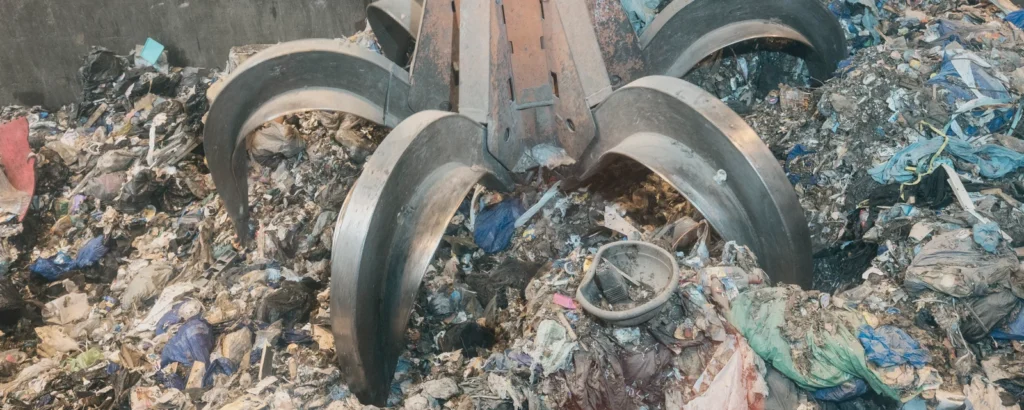
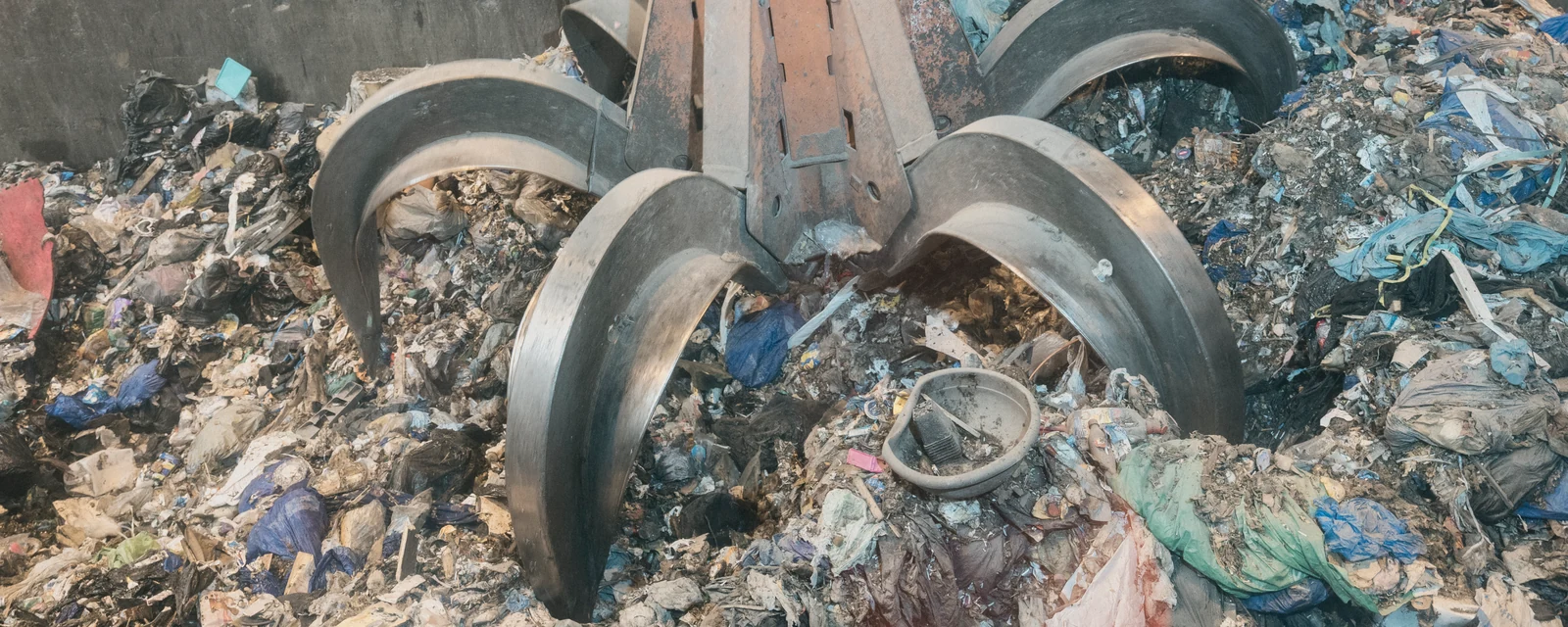
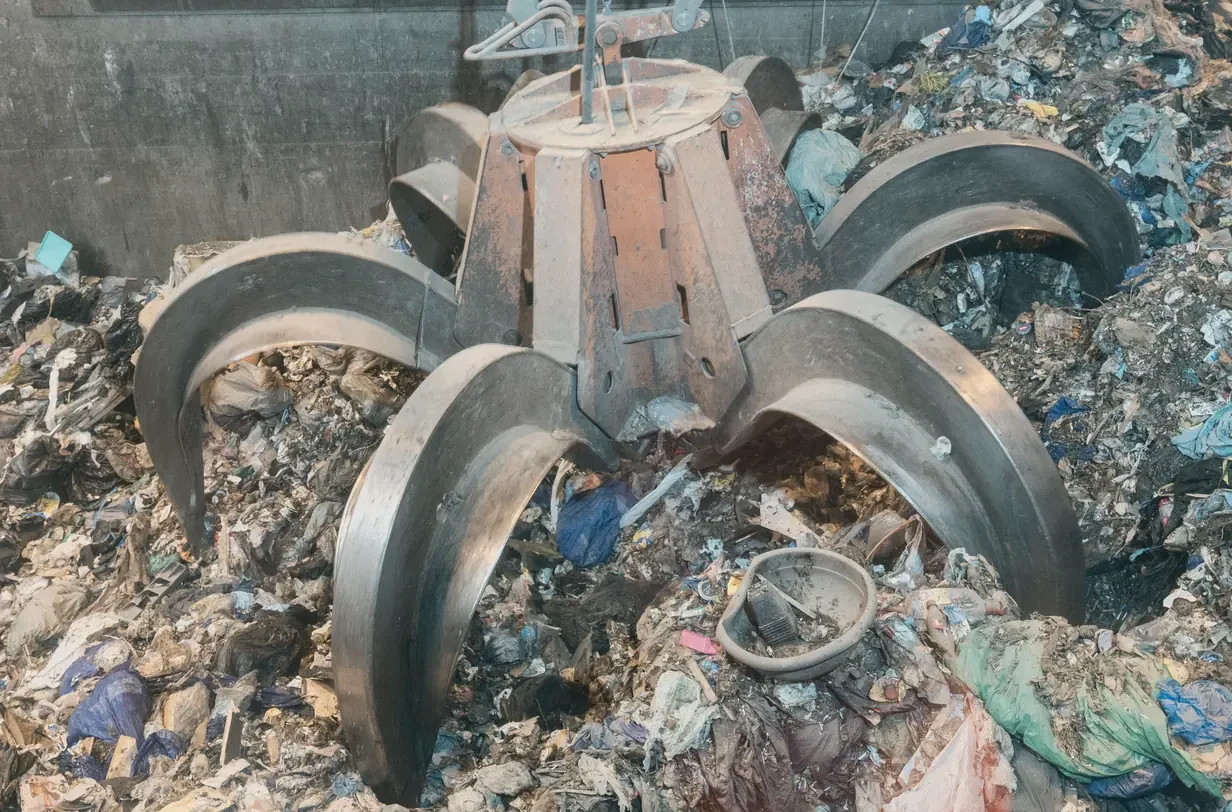
From his lofty control room high above, the operator looks down on a twenty-metre-thick layer of rubbish stretching down to the bunker floor. The steel gripper reaches into the chaos and loosens it. Materials from all over the world lie at the operator’s feet. Tennis balls, empty Coke cans, Star Wars Lego boxes, trainers, nappies, a tattered cuddly panda, an irreparable vacuum cleaner, dusty remnants of a birthday party: empty balloons attached to a glittering garland. Schweingruber says: “You can find the whole periodic table in there.”
It all goes into the furnace. The fire burns constantly. It crackles, blazes and hisses around the clock. It is switched off just once a year, for maintenance. When the incinerator chambers start up again afterwards, the staff waste no time. They sometimes start the fire using a Molotov cocktail. Once it is burning, combustion air continues to feed the fire. Before long, the temperature in the furnace has reached one thousand degrees again – a veritable inferno. A reverse-acting grate continuously propels the occasionally obstinate rubbish back into the fire, so that even the last bits and pieces go up in flames.
This furnace is where the energy that went into the products of our affluent lifestyle is burned. However, some of it is also recovered. A tunnel channels the energy from the waste to the city’s central districts, providing electricity to 45,000 households and heating to 109,000.
Schweingruber looks through the little window, behind which the fire is blazing. He knows a thing or two about fire. Rubbish with a high calorific value, such as plastic, should be heated slowly to allow the moisture to escape. Occasionally, sudden spikes of temperature can occur. If, for example, bales of straw are shoved into the furnace, they will burn fiercely, draw in vast amounts of air, and cause a considerable rise of temperature. Recently, a party drug has been posing a threat to the facility: nitrous oxide. People often throw away metal bottles that are still half full. They explode in the incinerator and blow craters in the walls. “They can make quite a bang,” says Schweingruber.
In the vast hall of waste, the operator guides the steel grab towards the next pile. Soft music plays in the background.
With some imagination, the facility could be the intestine of a giant. In its pipes, you hear loud rumbling, gurgling and growling, later reduced to nothing but a soft burble. The waste, first large and bulky, gets smaller and smaller. If you have not studied chemistry, you will now come across a few new terms in every sentence: in a process known as acid fly ash washing, the fly ash is dissolved in an acid solution. Chlorides and halogens are separated and filtrated. Vibrating tables fractionate the metals.
Was nach dem Inferno übrig bleibt, ist eineglühende Mine. Aus einer Tonne Abfall ergeben sich am Ende 150 Kilo Schlacke, 22 Kilo Flugasche, 7 Kilo giftiger Hydroxidschlamm. 3’900 Tonnen Rückstände pro Jahr. Über die Eisenabscheidung werden jährlich 550 Tonnen Metall zurückgewonnen. Kugellager, Ketten, Schrauben, der geschmolzene Aludeckel eines Joghurts – alles wird hier sortiert. Die restliche Schlacke wandert am Ende in die Reaktordeponie Kehlhof im Thurgau: asbesthaltige Materialien, nicht brennbarer Industriemüll, reaktionsfähige Abfälle.
What remains after the inferno is a smouldering pit. One tonne of waste ultimately produces 150 kilograms of slag, 22 kilograms of fly ash and 7 kilograms of toxic hydroxide sludge. 3,900 tonnes of waste per year. By separating iron, 550 tonnes of metal are recovered each year. Ball bearings, chains, screws, the melted aluminium lid of a yoghurt pot – everything is sorted here. The remaining slag is ultimately sent to the Kehlhof reactor waste disposal site in Thurgau: materials containing asbestos, non-combustible industrial waste and reactive waste.
In the past, rubbish used to be dumped into pits. To date, the Swiss Federal Office of the Environment has recorded almost 40,000 contaminated sites: landfills, industrial sites, accident sites. Many of these legacy sites date back to a time when there were no environmental laws and waste was simply buried. One of the low points in Switzerland’s environmental history is the hazardous waste landfill site in Kölliken, Canton Aargau. Once a landfill site for residential and industrial waste, a toxic leachate seeped into the groundwater, turning Kölliken into one of the most expensive clean-up operations in the country. The costs of investigations, decommissioning, disposal and post-decommissioning measures amounted to around 900 million Swiss francs.
These days, we no longer bury our waste. We burn it at one thousand degrees Celsius. Back in the control room, Schweingruber looks at the graphs showing the furnace temperatures. Everything is fine. Outside, in the vast waste hall, the operator steers the steel gripper towards the next pile. Soft music plays in the background while his gripper loosens the periodic table. The hum of the furnaces lingers in my ears for a long time, only fading away after a while. Like a foretaste of the silence that awaits me when I step onto the black carpet in the hereafter.
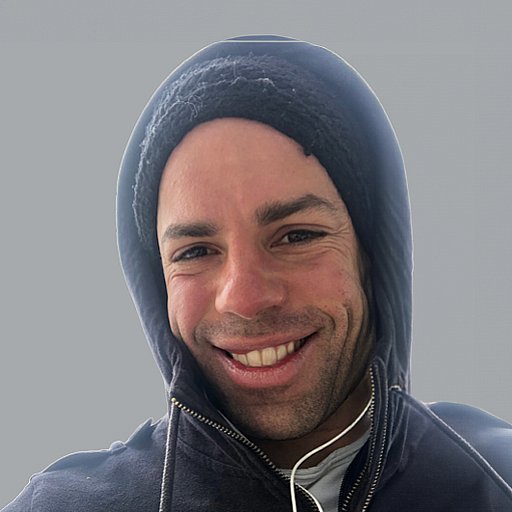
Florian Leu
was born in 1984 and worked as a reporter and editor at the “Tages-Anzeiger”, the magazine “Reportagen” and “NZZ Folio” for over ten years. The journalist and author now works as a freelance writer and teaches writing at various institutions for higher education (University of Zürich, Zürich University of Applied Sciences, SAL School for Applied Linguistics).